
The future of high schools
High schools are a surprisingly recent institution, emerging during the early twentieth century as societies recognized the importance of educating teenagers before adulthood. Over the past hundred years, classrooms have adopted new technologies while still relying on the essential role of human teachers.
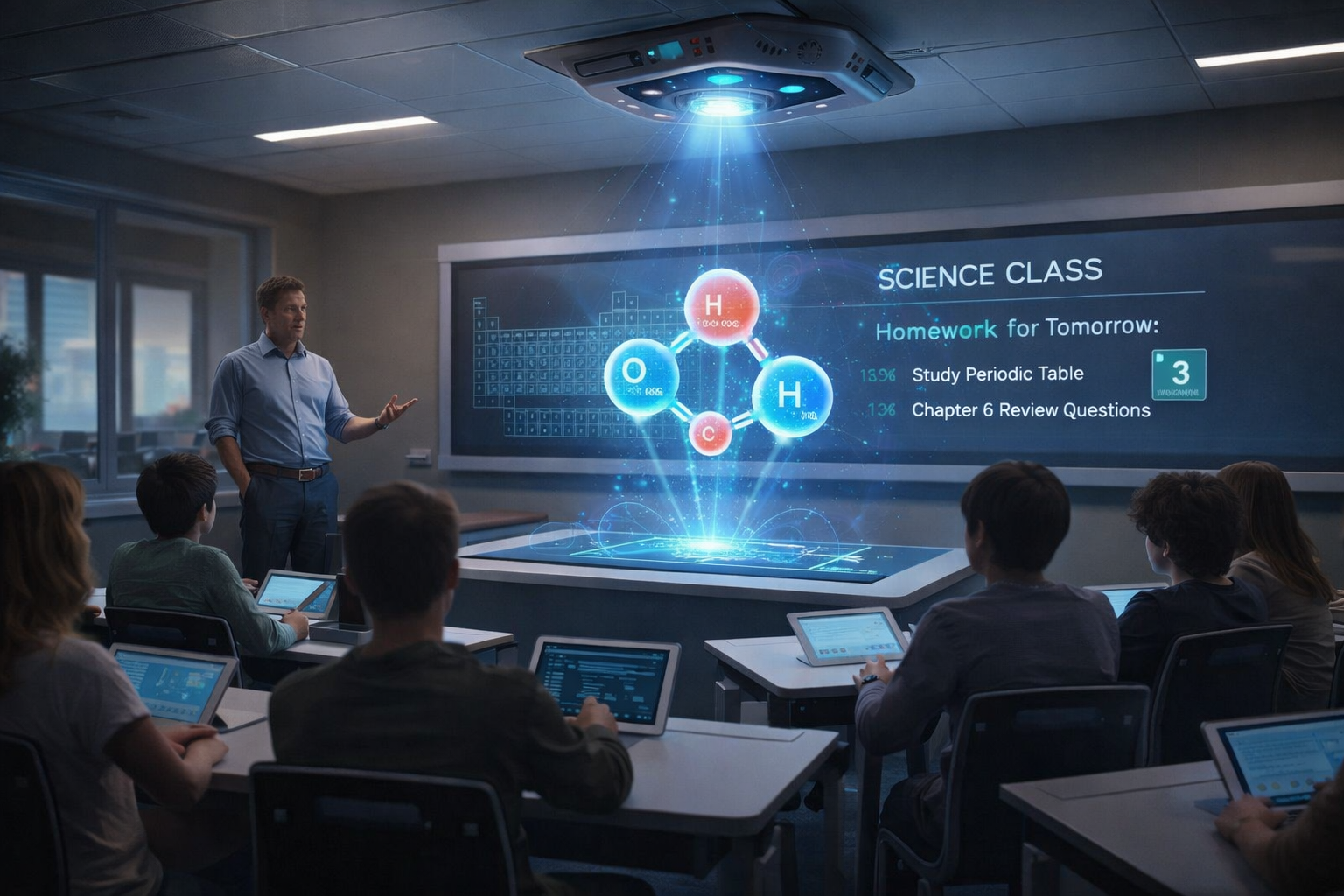
The first two articles in this series focused heavily on technology, with the previous article exploring televisions — one of the most recognizable pieces of technology in the modern home. In this article, I wanted to step slightly away from pure technology and explore something more social: high schools.
High schools may also be called secondary school, senior school, or collegiate depending on the country and culture. Education as a whole is a vast subject that could fill an entire book, so for the purpose of this article I decided to focus specifically on the high school years.
Interestingly, high schools as we know them are actually a fairly recent invention.
For most of human history, teenagers did not attend school at all. Young people typically entered the workforce early, often through apprenticeships, farming, or family trades. Education beyond basic literacy was usually reserved for the wealthy or for those entering religious or scholarly professions.
That began to change during the late nineteenth and early twentieth centuries.
During this time, something remarkable happened. Society began to believe that adolescence should include more education rather than immediate entry into work. Industrial economies were becoming more complex, and governments realized that a more educated population would strengthen both economic development and civic life.
This period is now often referred to as the High School Movement.
Between roughly 1910 and 1940, thousands of high schools were built across North America. For the first time, large numbers of teenagers remained in school until the age of eighteen. What had once been a privilege for a small portion of society became the expected path for an entire generation.
Over the decades, the technology inside high schools has changed dramatically.
In the early twentieth century, classrooms relied on chalkboards, printed textbooks, and handwritten assignments.
By the late twentieth century, computers began appearing in schools. Soon after, the internet opened access to vast amounts of information. Libraries expanded beyond physical books into digital resources that could be accessed from almost anywhere.
In the early twenty-first century, digital tools such as tablets, learning platforms, and online classrooms became increasingly common. The COVID-19 pandemic accelerated this trend dramatically, forcing schools around the world to experiment with remote learning almost overnight.
Despite all of these technological changes, one thing remained surprisingly constant: the human teacher at the front of the classroom.
Technology has repeatedly proven itself to be a powerful educational tool, but it rarely replaces the role of teachers themselves. Teaching is not only about delivering information; it is also about guiding discussion, encouraging curiosity, and helping students navigate difficult ideas.
Today’s high schools continue to evolve as society changes. Some emphasize academic pathways toward university. Others focus more heavily on skilled trades, technology, or specialized career training.
Education systems constantly adjust to new realities: economic shifts, technological advances, and changing ideas about what young people need in order to thrive.
The concept of high school itself — teenagers spending several years learning together before entering adulthood — has now existed for only about a century.
Which raises an interesting question.
If high schools have changed so much in just the past hundred years, what might they look like one hundred years from now?
When I brought this question to educators and non-educators alike, I was surprised by the responses. Many people believe the traditional high school may eventually disappear. Some predictions were quite pessimistic, suggesting the education system we know today might collapse entirely. Others imagined education remaining the same but moving completely into the home through digital platforms.
Personally, I find that vision somewhat bleak. Many people have powerful memories of growing up in schools — meeting friends, participating in activities, and sharing experiences with others their age. Early social interaction plays an important role in development, and schools provide a place where that interaction happens naturally.
For that reason, my own view of the future is far more optimistic.
I suspect the education system one hundred years from now will still look surprisingly familiar. Human teachers will likely remain central to the classroom experience. While technology will continue to evolve, the role of the teacher — guiding students and shaping discussion — is something that technology has never fully replaced.
What will change is the tools available to those teachers.
Future classrooms may include technologies that today still feel experimental: virtual reality, immersive simulations, or even entire classroom walls functioning as interactive displays. These tools could allow teachers to transform the classroom environment depending on the lesson.
When studying the Middle Ages, for example, students might spend a day walking through a virtual reconstruction of a medieval castle. When learning about astronomy, the classroom could become a fully immersive view of the night sky.
Yet these tools would likely be used thoughtfully, much like televisions have been used in classrooms for decades — not constantly, but when they genuinely enhance learning.
Another fascinating thought experiment is imagining what high schools might look like beyond Earth.
Suppose humanity eventually establishes colonies on Mars, or even in another solar system such as Alpha Centauri. How would education need to adapt to those environments?
In many ways, the structure of education might remain the same. The same basic model of teachers guiding groups of students has proven remarkably effective. However, the curriculum would likely evolve to reflect the realities of life on another world.
Local history might focus on the early colonists who built the settlement. Students might also learn essential safety knowledge unique to their environment — how life-support systems work, how habitats are maintained, or how to respond to emergencies in a hostile planetary environment.
Imagine being fourteen years old and living in a Martian colony.
It is Monday morning, and you walk to school just as teenagers on Earth do — except that you travel through connected buildings designed to protect everyone from the harsh Martian environment outside.
Inside the classroom, things might look surprisingly familiar. Students sit at desks arranged around the room, perhaps with tabletop displays integrated into the surfaces. At the front stands a human teacher greeting the class.
Behind them, a wall display replaces the whiteboard, capable of showing images, video, or interactive lessons. Some walls might even simulate windows displaying what Earth’s sky or landscapes once looked like.
The teacher begins the lesson much like teachers do today, discussing the previous day’s work and reviewing homework with the class.
Later in the day, the teacher announces a field trip.
Not a physical one, but a virtual one.
Students place lightweight virtual-reality devices on their heads, and suddenly the class is standing together beneath the Eiffel Tower in Paris. They explore the city, observe the architecture, and discuss French history while sharing the experience together inside a simulated environment.
In my research for this topic, I’ve discovered that education is one of the hardest institutions to predict. It evolves slowly and is deeply connected to culture, technology, and economics.
That is why I often describe this series as a positive thought experiment about what might be possible.
I could easily be wrong. Many predictions about the future turn out to be mistaken. But exploring these possibilities helps us think about the kind of world we might want to build.
And sometimes, asking the question is just as interesting as finding the answer.