
Will Television Survive the Next Century
From spinning mechanical disks in the 1920s to today’s ultra-thin smart screens, television has evolved dramatically. But will it truly change in the next 100 years — or simply adapt and endure?
In the last article, we explored food printers and the possibilities they could create in our kitchens and restaurants.
Today, I want to turn to something far more familiar — a device that many people use daily, and perhaps more than any other item in their home: the television.
The first televisions weren’t sleek screens mounted on living room walls. They were spinning metal disks and flickering silhouettes in dim laboratories in the 1920s. In 1925, John Logie Baird demonstrated one of the first working mechanical television systems, publicly showing moving images in London the following year.
Just two years later, in 1927, Philo Farnsworth demonstrated the first fully electronic television system in the United States. This electronic breakthrough is what modern television descends from. Regular public broadcasting began in 1936, when the BBC launched what was considered high-definition television at the time.
From spinning disks to wall-mounted OLED panels, television has transformed dramatically in less than a century.
Today’s televisions are thinner, brighter, sharper, and more affordable than ever. Even households of modest means can afford not only a television, but also streaming devices and subscriptions that provide access to thousands of shows and films.
Yet here’s the interesting part: I don’t actually see television changing dramatically in the next 100 years.
Manufacturers continue to advertise each new model as revolutionary. Higher resolution. Brighter colours. Deeper blacks. But most improvements today are incremental rather than transformative. There is a practical limit to how much resolution the human eye can meaningfully perceive at normal viewing distances. Beyond a certain point, sharper stops mattering.
So what might realistically change?
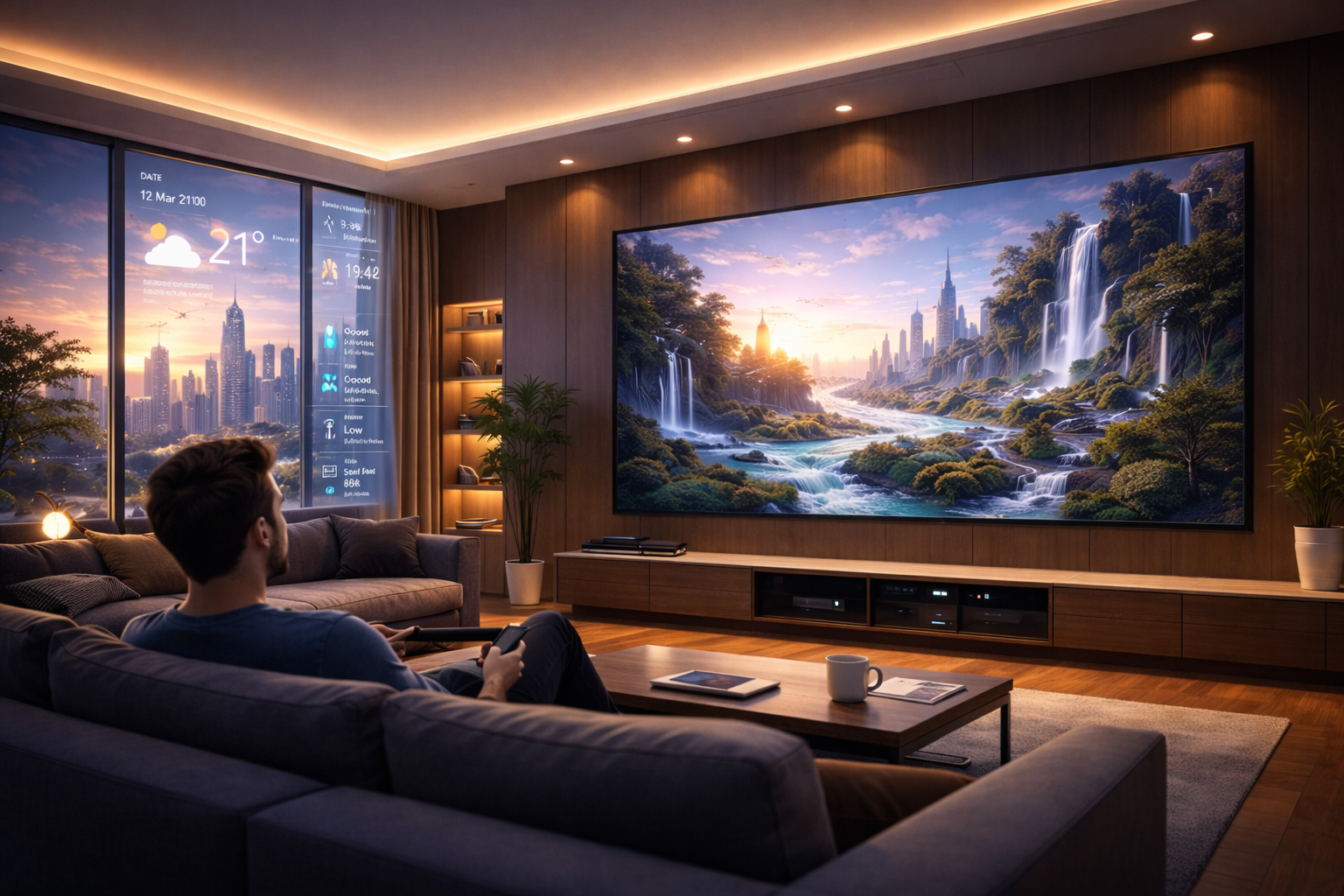
One possibility is integration. Instead of televisions being distinct devices, entire walls could function as displays. A living room wall might shift seamlessly between showing art, weather updates, ambient lighting, video calls, and entertainment. In that sense, the “television” disappears — not because it’s gone, but because it becomes part of the architecture itself.
Science fiction often imagines holographic displays or immersive 3D projections. That isn’t unreasonable. We already have early forms of 3D displays and experimental holographic technologies. It’s plausible that within 100 years — perhaps much sooner — glasses-free 3D viewing could become common.
But I doubt it replaces traditional viewing.
Sometimes people don’t want immersion. They want comfort. They want to sit on a couch, unwind, and watch something simple on a screen. Immersion is powerful — but it is also demanding. Television’s enduring strength is that it asks very little from us.
Virtual reality presents another possible competitor. In my own fiction series, I explore a device called the virtual slider, a fully immersive entertainment system. And it’s easy to imagine many people preferring to step inside their stories rather than watching them unfold on a wall.
Yet even here, I don’t see replacement. I see coexistence.
The future of television may not be about one technology overtaking another. It may be about choice. Some nights might call for full immersion. Others for holographic novelty. And still others for the simple comfort of a picture on a wall.
Television has survived nearly a century not because it was the most advanced technology, but because it fit naturally into human life.
That may be its greatest advantage in the next hundred years as well.
The future is unwritten, but we can always choose hope.