
Cell phones of the future
Cell phones, the most used device of most peoples lives. Will it survive 100 years into the future and, if so, what will it look like.
In the previous article, we explored how high schools might evolve in the future. This time, I want to return to something more technological.
While writing the second book in the Beneath Still Stars series, I found myself thinking about what devices the characters would carry. With smartphones having such a massive impact on our world today, it felt impossible to ignore them when imagining a realistic future.
So I decided to dedicate this article to personal devices—and build on some of the research I did for the book.
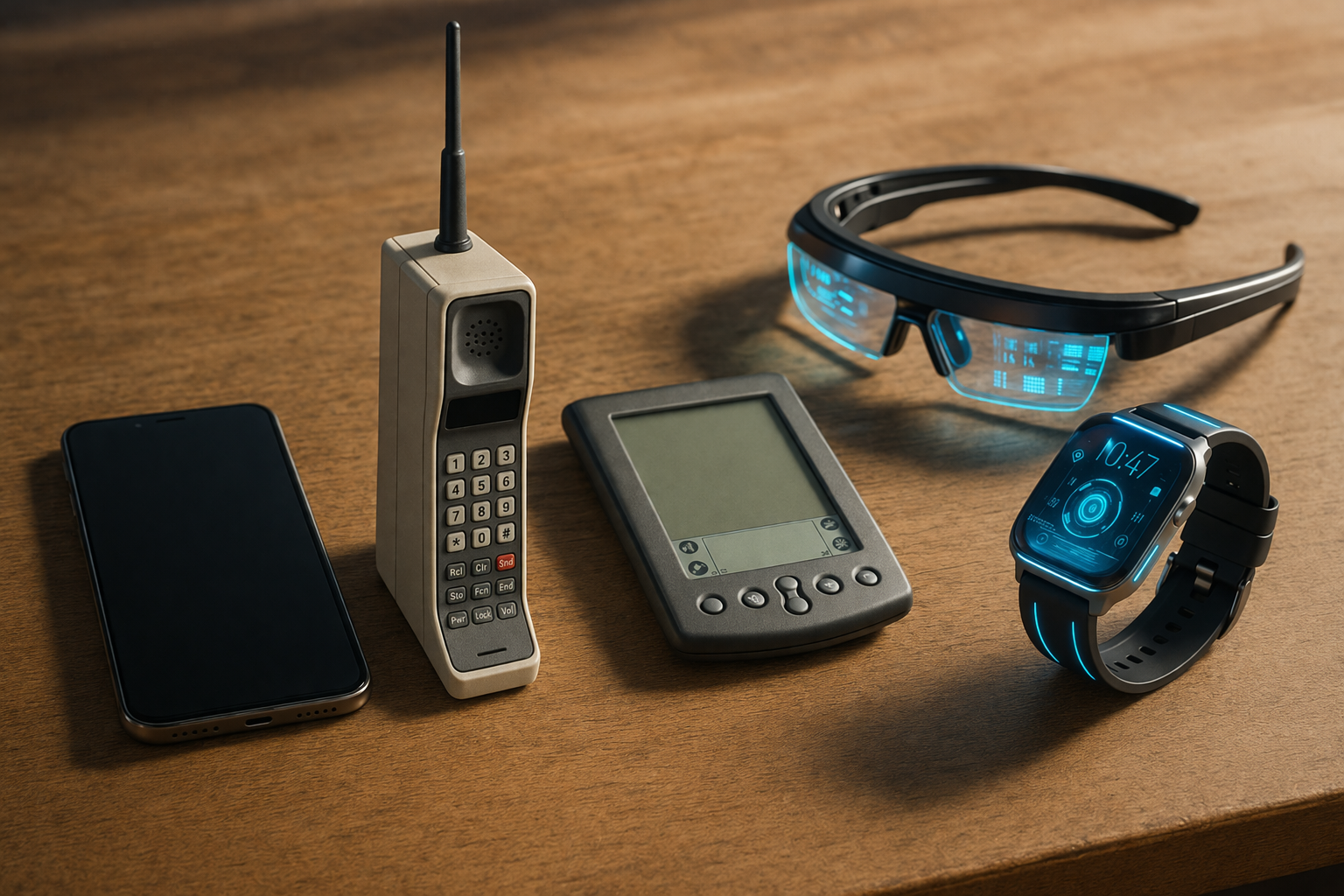
On April 3, 1973, Martin Cooper, a Motorola researcher and executive, made the first handheld mobile phone call, placing it to a rival at Bell Labs. The prototype device weighed about 2 kilograms (4.4 lb) and measured roughly 23 × 13 × 4.5 cm—hardly what we would call “personal” today.
This early device eventually led to the Motorola DynaTAC 8000X, often referred to as “the brick,” which became commercially available in 1983.
We don’t truly reach modern “personal devices” until the 1990s, with smaller mobile phones and early handheld computers like the Apple Newton and PalmPilot. These devices—and eventually smartphones, which combined their capabilities—formed the foundation of what we now carry every day.
Today, smartphones are nearly universal. Even people with little interest in technology rely on them daily. Alongside them, smartwatches and tablets have become deeply integrated into everyday life.
The Near Future
Looking ahead, I don’t expect dramatic changes in the short term.
Smartphones, watches, and tablets are massive, established markets. Progress will likely come in incremental improvements—better performance, better battery life, better integration—rather than complete reinvention.
One area of change may be smart glasses. These could become as common as smartwatches, offering another way to interact with personal devices without replacing them entirely.
Looking Toward 100 Years
Projecting a full century ahead is much more difficult.
Despite how quickly technology evolves, smartphones are so deeply embedded in daily life that it’s hard to imagine them disappearing completely. Even 100 years from now, some form of handheld personal device may still exist.
But if the form changes, what replaces it?
The answer likely depends on the person.
For most people—those who simply want a reliable, easy way to communicate and interact with the world—a highly advanced wearable device may take the lead. A smartwatch, far more powerful than today’s versions, could act as the primary computing device.
Paired with smart glasses or even contact lenses, users might see information projected directly into their field of vision through augmented reality or holographic displays. The “screen” would no longer be something you hold—it would exist around you.
In this sense, the evolution is not a leap, but a gradual shift: the device becomes smaller, while the experience becomes larger.
For more technically inclined users, or those who prefer more control, traditional devices may persist.
Smartphones could remain as powerful, customizable tools. Tablets may evolve into full computing platforms, potentially replacing laptops—if they become open enough to support more advanced operating systems beyond today’s mobile environments.
A Glimpse Forward
It is June 21, 2149.
A 30-year-old man steps off a transit line in a Mars colony. As he walks through a shopping district, his smart glasses display layered information over each storefront—sales, recommendations, and details filtered through preferences stored on his wrist device.
A soft tone sounds—heard only by him.
He taps his wrist.
A life-sized holographic image of a woman appears beside him, as if walking at his side. They begin talking naturally as he continues forward, moving through the crowd.
There are no phones in his hands. No screens to hold.
Only a watch—and a pair of glasses.
Summary
Personal devices may not disappear in the future—but they may become less visible.
Rather than something we carry, technology may become something we wear, or even something that surrounds us.
The question is no longer what a device looks like.
It is how seamlessly it becomes part of our everyday lives.