
Return to the Moon
In honour of the artemis II mission we will be looking at future life on the moon in 100 years
In the last article, we explored one of the most important technologies in our daily lives—the personal device. If you haven’t read it yet, I encourage you to take a look.
For this article, I wanted to honour the upcoming Artemis II mission, which includes fellow Canadian Jeremy Hansen. It marks a significant moment: humanity’s return to deep space after more than 50 years.
This time, we are not simply going back to visit.
We are going back to begin something new.
The Moon has always been a constant presence in our lives. It has guided calendars, inspired stories, and served as a quiet companion in the night sky. For most of human history, it was something we could only observe.
That changed in the 20th century.
Since then, multiple missions—both crewed and robotic—have expanded our understanding of the Moon. We now know it is not just a barren rock, but a place with resources, history, and potential.
Today’s return to the Moon is often described as a stepping stone toward Mars. That is true.
But for this article, I want to focus on something closer to home:
What happens when we return—and stay?
The current plans for returning to the Moon include establishing a sustained human presence, supported in part by the Gateway, a space station that will orbit the Moon.
Even in its earliest stages, this represents a major shift. Humanity is moving from short visits to continuous presence.
It is not difficult to imagine that this presence will expand over time.
At first, activity on the Moon will focus on research and exploration. Scientists will study the lunar environment, test new technologies, and prepare for deeper space missions.
But as infrastructure grows, so will opportunity.
One of the most important resources on the Moon is water ice, particularly near the lunar poles. This water can be used to support life, and potentially broken down into hydrogen and oxygen to create rocket fuel.
Local materials such as regolith—the Moon’s surface dust—could also be used for construction, allowing habitats to be built using resources already available on the Moon.
Over time, this could lead to the development of mining operations. Initially, these would support local construction and fuel production. In the more distant future, valuable materials could potentially be transported back to Earth.
Tourism is another possibility—and perhaps sooner than we expect.
We already have the early beginnings of commercial space travel. As costs decrease and technology improves, short trips to the Moon could become accessible to more people.
Within the next 50 years, it is not unreasonable to imagine limited lunar tourism.
Given enough time, this could expand into something more ambitious: hotels, observation domes, and even dedicated tourist facilities designed to let visitors experience the Moon’s unique environment.
The next step beyond that is permanent habitation.
At some point, humans may begin living on the Moon long-term. Eventually, we may even see the first generation of people born there.
Living on the Moon does present challenges. One of the most significant is gravity, which is only about one-sixth of Earth’s. Over long periods, this could affect human health.
Possible solutions include rotating habitats that simulate gravity, or medical advances that help the human body adapt.
These are not simple problems—but they are not unsolvable.
Looking ahead 100 years, it is possible to imagine the Moon dotted with multiple settlements.
Each one might serve a different purpose:
• research stations
• mining operations
• transportation hubs
• tourist destinations
• permanent residential communities
Some may specialize. Others may grow into small, self-sustaining settlements.
Now imagine this:
It is the year 2147.
You take your family on a short weekend trip. Lunar travel has become routine, and this time of year the prices are lower.
The journey is quick compared to the past—what once took days now takes only hours.
You arrive at a settlement built beneath protective structures on the Moon’s surface.
The family spends the day exploring a recreational complex designed for low gravity. You try rock climbing where every movement feels effortless. You play basketball where even the least athletic person can perform a perfect dunk.
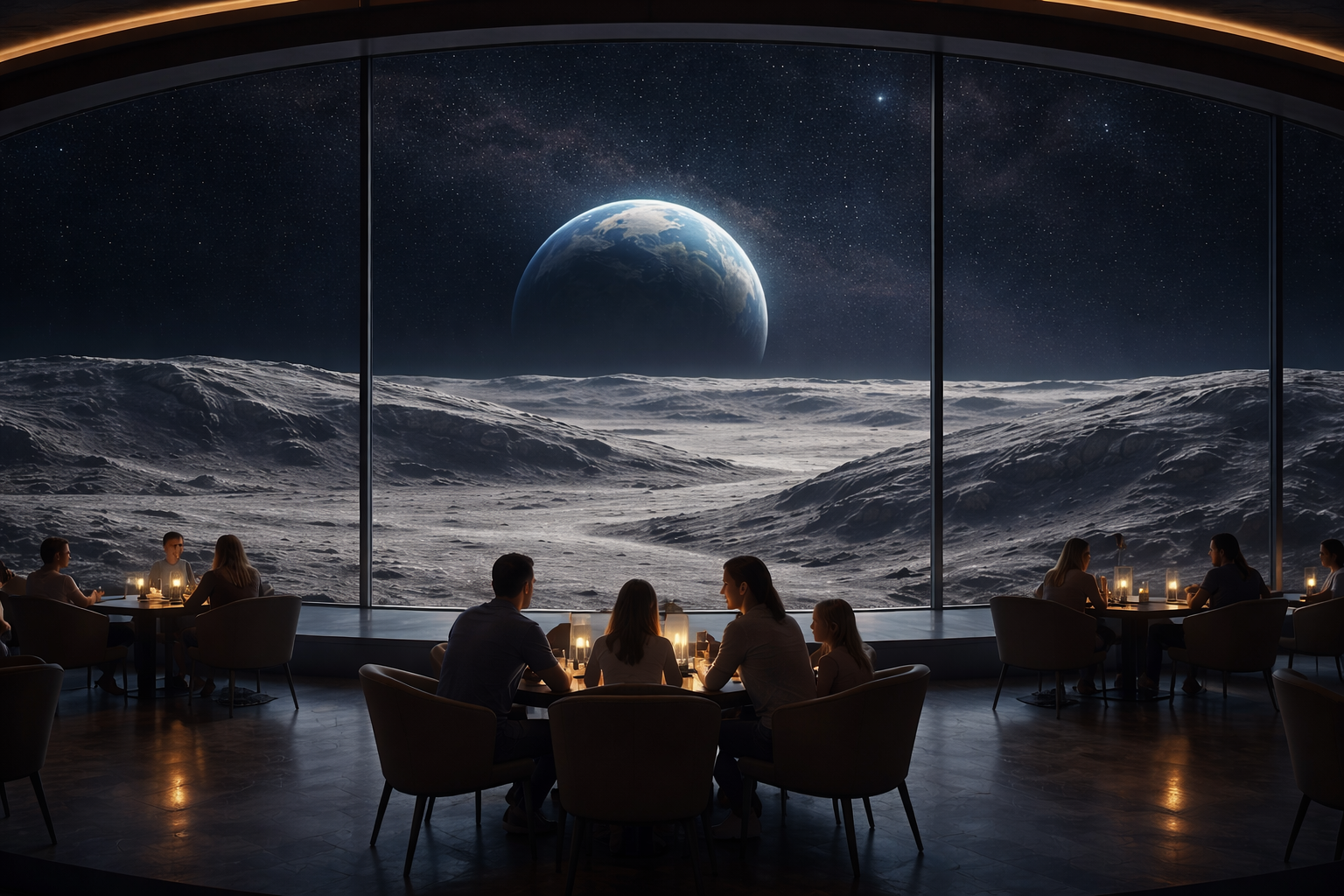
Later, you sit down for dinner.
Through a wide observation window, you see the Moon’s surface stretching into the distance—and above it, a crescent Earth hanging quietly in the sky.
For a moment, it feels both familiar and completely new.