
Food Printers
When meals are printed to spec, what happens to convenience and work?
To my surprise, we already have food printers today—and they’re not just laboratory curiosities. They exist, they work, and they’re quietly being used in both residential experiments and commercial environments.
3D food printing is a form of additive manufacturing, where food is created layer by layer rather than cooked or assembled in traditional ways. Most current systems use food-grade syringes filled with printable ingredients—things like chocolate, doughs, purées, or protein pastes—which are extruded through a food-safe nozzle with precise control.
More advanced food printers already include pre-loaded recipes and allow users to design or modify food digitally from a computer or tablet. In other words, the food is programmed before it’s eaten. This isn’t a brand-new idea either. One of the earliest examples dates back to 2006, when students at Cornell University developed Fab@Home, the first open-source, multi-material 3D printer. Among other things, it successfully printed chocolate, cookie dough, and cheese—proving that food could be manufactured digitally, not just theoretically.
Looking forward, the continued development of food printing makes practical sense. Researchers are already exploring how this technology could help address growing food demands by using ingredients people might otherwise reject—such as alternative proteins or nutritionally dense plant bases—and transforming them into foods that are familiar, appealing, and palatable. Space agencies are also paying attention. NASA has funded research into 3D food printing as a way to support astronauts on long-duration missions, where food variety, nutrition, and storage efficiency become critical. The European Space Agency has explored similar sustainability and food-system questions through ISS research. What’s important here is that food printers are no longer science fiction. They’re being sold today—primarily to research institutions, specialty restaurants, and early adopters—and they work well within their current limitations.
This is one technology where we don’t need to look a full 100 years ahead to imagine real societal impact. Even within 50 to 75 years, food printing could significantly change how we think about convenience food. As printed meals begin to rival traditional processed foods in taste—and surpass them in nutritional control—it’s easy to imagine them replacing microwavable meals in many homes.
A more provocative possibility is fast food. Imagine a future fast-food restaurant where the entire menu is produced by advanced food-printing systems. Every burger, every sandwich, every meal would be created to exact specifications—perfectly consistent, nutritionally optimized, and produced with minimal waste. These systems could operate with little or no direct human involvement, potentially reducing a full restaurant staff to a single technician overseeing maintenance and logistics.
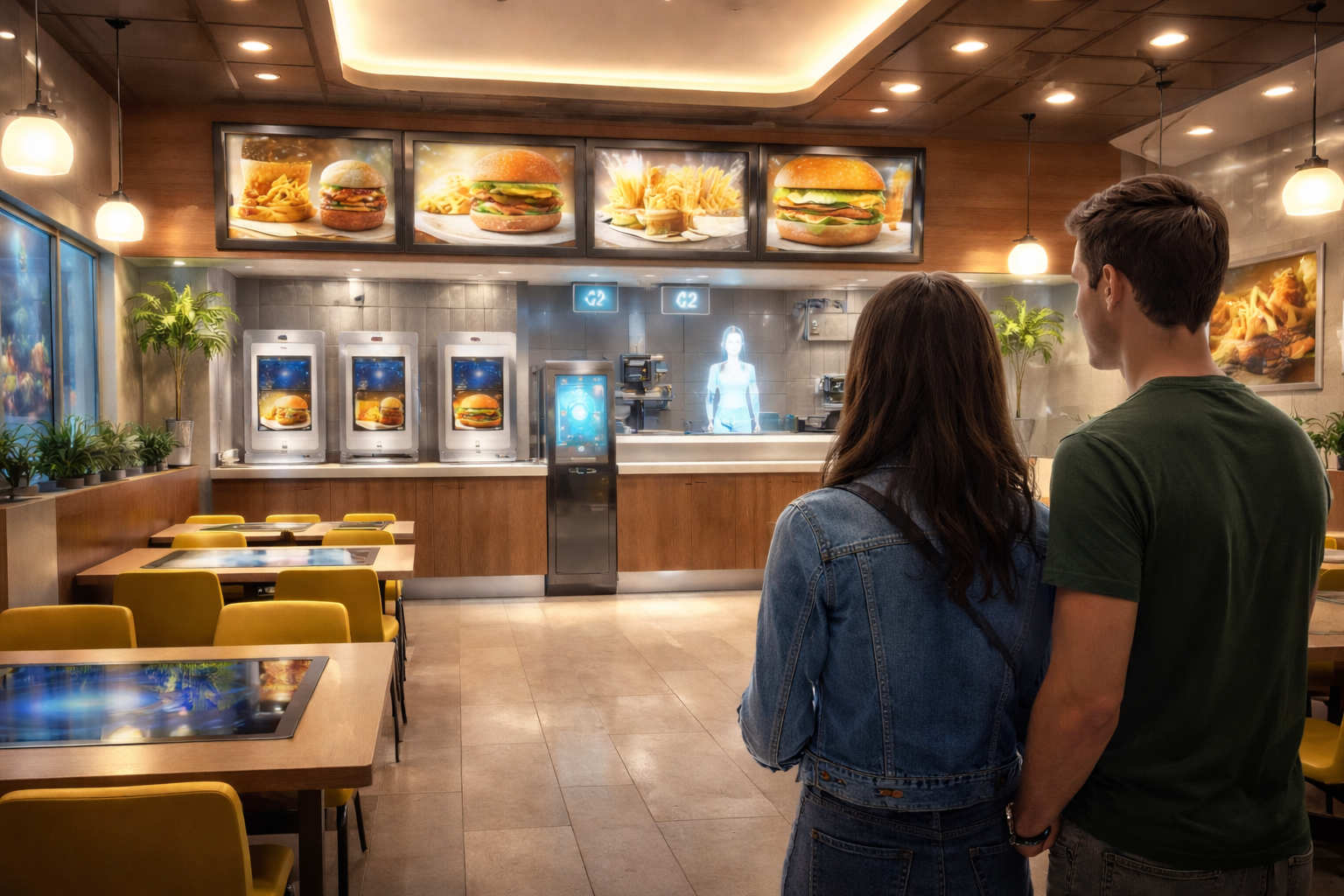
Now picture a couple walking into a fast-food restaurant around the year 2100. They look around, at first glance, it looks familiar to something we would see. Tables line the room. The lighting is warm and comfortable. Images of food still decorate the walls. The couple continues to the front of the restaurant where we would normally see a cashier, but this couple sees a holographic image appear in front of them. Generated by AI it speaks and completely human. With exception to the one human they see working in the back, maintaining the machines, there is no other human present. With the holograms help the couple orders a completely custom made meal. Two hamburgers with 20% reduced beef taste, with exactly 30ml of ketchup with 10% extra sugar added. French fries that are thick cut with a particular wavy pattern they couple seen on the internet earlier and wanted to try. After ordering their food with the AIs help they go to the dispenser machine. You would not know it is doing anything except for a small hum then the door open revealing a try with their meal prepared as order. Hot and ready to eat.
The difference appears at the counter. There’s no cashier. Instead, ordering happens through personal devices, kiosks, or even a projected interface. Food is printed and prepared behind the scenes, then delivered through a wall unit—or perhaps directly to the table. The restaurant hasn’t vanished. It’s simply changed how it creates food.
This isn’t a prediction. It’s a possibility. But it’s one rooted in technologies that already exist, quietly advancing, and waiting for the moment when convenience, cost, and culture align.