
How technologies take over
Every generation experiences technologies that fundamentally reshape society. From steam engines to smartphones and artificial intelligence, humanity continues to balance wonder, fear, and adaptation.
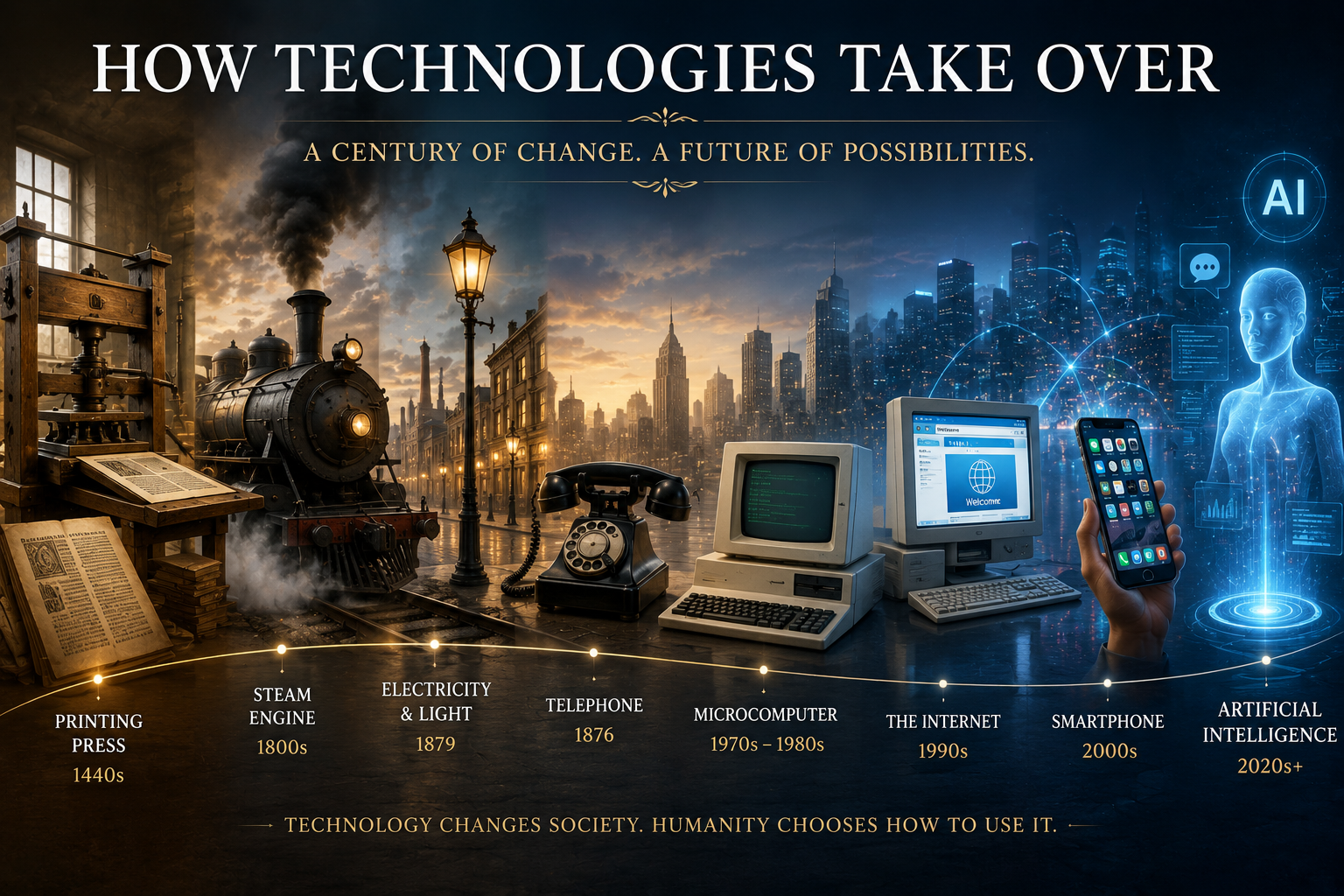
Every few decades, a technology arrives that feels different from the others.
These are not simply new inventions or small improvements. They are technologies that reshape society itself. Technologies like the printing press, the steam engine, electricity, the microcomputer, the internet, and now artificial intelligence.
These technologies create wonder and opportunity, but they also create uncertainty and fear.
When steam engines became common, many feared massive job losses. When electricity spread into homes, people worried about safety and social change. Early telephones were criticized for reducing face-to-face interaction. Even microwaves caused anxiety when they first became common household devices.
Transformative technologies do not simply give people new tools. They change how people work, communicate, think, and live.
And sometimes those fears are justified.
The steam engine did eliminate many traditional jobs, but it also created entirely new industries and opportunities. Electricity changed human life so dramatically that it even altered sleep patterns by extending activity long after sunset. The internet connected the world in ways previous generations could barely imagine, but it also introduced misinformation, digital addiction, and entirely new forms of social pressure.
Technology rarely changes only one thing.
One of the most recent major transformations before artificial intelligence was the smartphone.
The smartphone quietly changed daily life for billions of people. Today, it is almost impossible to walk down a street without seeing people looking at their devices. Smartphones changed communication, entertainment, navigation, photography, shopping, relationships, and even how people experience boredom.
The effects spread everywhere:
- at dinner tables
- in classrooms
- while driving
- across workplaces
- throughout social life
Even bullying changed as society shifted into a permanently connected digital world.
And now we arrive at artificial intelligence.
Not older specialized systems like computers playing chess, but modern generative AI systems such as OpenAI’s ChatGPT and similar technologies.
AI feels different to many people because it affects something deeply human: language and thought itself.
Previous technological revolutions often replaced physical labor or repetitive tasks. AI has the potential to influence writing, art, education, communication, programming, customer service, and many other forms of mental work.
That possibility excites some people and deeply worries others.
Some imagine a future filled with incredible productivity and creativity. Others fear job loss, misinformation, dependency, or the loss of human originality.
For the first time in my life, I have personally felt part of one of these technological shifts.
As a writer, I now sometimes need to confirm that my work was written by a human. Ironically, this is often checked using AI systems themselves. And yes, this article was written by a human being—on a smartphone, another technology that once dramatically changed society.
History shows that humanity rarely rejects transformative technologies entirely. Instead, society slowly adapts to them.
Some technologies disappear.
Others become so deeply woven into life that people stop noticing them altogether.
Electricity once felt revolutionary. Today it is simply expected.
The internet once sounded futuristic. Now it is infrastructure.
I believe artificial intelligence will follow a similar path.
That does not mean every fear surrounding AI is irrational. Every major technological shift creates winners, losers, opportunities, and consequences. Some jobs will likely disappear. Entire industries may change. Education, creativity, and communication could all evolve in ways we do not yet fully understand.
But I also believe humanity will continue doing what it has always done:
adapting.
In the future, I expect more breakthroughs that challenge society in ways we cannot fully predict. Some of them will inspire excitement. Some will create fear. Some will probably do both at the same time.
AI may eventually greet us in restaurants, assist doctors, teach students, help create entertainment, and quietly manage systems most people never even think about.
In many ways, that future has already begun.
Technology changes society, but humanity still chooses how to use it.
The future is unwritten, but we can always choose hope.